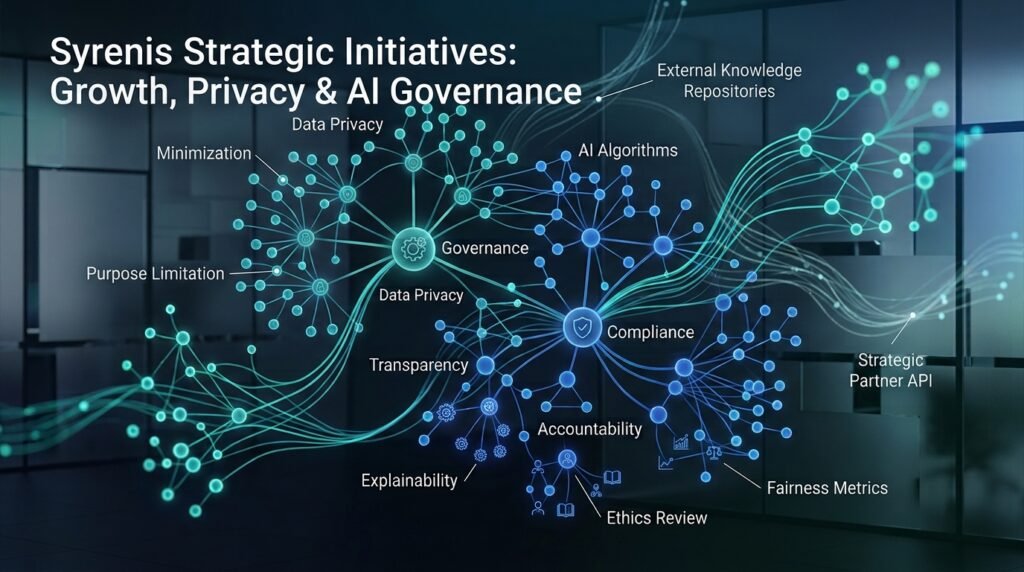
Syrenis strategic initiatives are the main business and technology plans Syrenis uses to grow its enterprise privacy platform. They cover consent management, customer preferences, system integrations, global expansion, partnerships, and the use of trusted consent data for AI governance.
One point should be clear from the start. “Syrenis strategic initiatives” is not the official name of a single product or program. It is a useful label for several connected parts of the company’s strategy. This guide explains each part in simple language, so you can see how they fit together.
Quick View: Syrenis Strategic Initiatives at a Glance
| Area | What Syrenis is doing | Why it matters |
|---|---|---|
| Positioning | Moving from a compliance tool to an enterprise privacy platform | Opens a bigger business conversation |
| Brand | Unified Syrenis brand in 2026, older product names retired | Clearer identity |
| Core product | Consent, preference and privacy data management | Keeps customer choices accurate |
| Integrations | 350+ reported integrations, APIs, connectors | Moves consent data where it is needed |
| Expansion | US presence with offices in Austin and Atlanta, plus Daresbury, UK | Reaches North American enterprises |
| Partnerships | Alliances with consulting firms and a partner program | Adds implementation help |
| Governance | Risk, policy and rights-request tools | Goes beyond the consent banner |
| AI | Consent records as a base for AI data governance | Supports responsible data use |
What Is Syrenis and What Does It Do?
Syrenis is a privacy technology company. It builds consent and preference management software for large organizations.
The platform helps a business do four things:
- Capture the choices customers make about their data
- Link those choices to the right person or identity
- Share those choices with connected business systems
- Keep a record showing the choice was followed
Syrenis describes its platform around three connected ideas: consent management, preference management, and privacy data integration and orchestration. This is much wider than a cookie banner. A cookie banner collects a choice on one website. An enterprise needs that choice to stay accurate across websites, apps, CRM tools, email platforms, analytics tools, and customer service systems.
Here is a simple example. A customer opts in to marketing emails on a website. Later they change their mind in a preference center. After that they speak to a support agent. The business needs every one of those systems to agree on the latest choice. This is the problem Syrenis is built to solve.
Why Syrenis Is Moving From a Compliance Tool to a Platform
A basic consent tool is usually bought for one reason: to meet a privacy rule. An enterprise privacy platform serves a wider group of needs, including:
- Customer trust
- Data governance
- Privacy operations
- Marketing preferences
- Data quality
- Identity management
- Regulatory compliance
- Customer experience
- Responsible AI
This changes the question buyers ask. Instead of “How do we show a cookie banner?”, they ask “How do we make privacy decisions consistent across our whole customer data setup?” That is a bigger problem, and it supports a bigger product. Much of the Syrenis strategy follows from this shift.
The 2026 Brand Refresh
In April 2026, Syrenis announced a major brand refresh. The company said it was retiring older product names in favor of one unified Syrenis brand. It described the change as a move from a compliance-focused tool toward an enterprise platform for complex organizations.
Syrenis and the Cassie Platform
Cassie was the name closely linked with the Syrenis consent and preference platform for many years. It was built for organizations that need to manage large volumes of consent data across systems, brands, regions, and channels. If you research Syrenis, you may still find older pages that mention Cassie. Cassie and the newer Syrenis branding should not be treated as unrelated platforms. The 2026 refresh brought the older product identities under the Syrenis name.
Cassie-era capabilities included collecting consent and preferences, keeping time-stamped records of what a person agreed to and when, and passing changes to connected systems.
How Enterprise Consent Management Works
Enterprise consent management starts by recording what a person has agreed to. For example, a customer may accept emails but refuse text messages. Another may withdraw marketing permission completely. The hard part comes next: making sure every relevant system learns about that decision.
A large company may use a website, a mobile app, a CRM, an email tool, customer service software, marketing tools, and several internal databases. If each system keeps its own consent record, the records can disagree.
Syrenis connects each choice to the person or identity it belongs to. When the customer changes a choice, the update can be recorded and shared with connected systems. The platform also keeps a history, so a business can see what someone agreed to, when they agreed, and whether they later changed or withdrew consent.
This turns consent from a stored yes-or-no answer into data that other systems can act on.
Creating a Single Source of Truth
A central idea behind Syrenis strategic initiatives is a single source of truth for consent and preferences.
Without one, customer choices get scattered. An email platform may show someone as unsubscribed while another marketing database still lists them as subscribed. The result is unwanted messages and a harder privacy audit. A central record helps in three ways:
- Marketing, privacy, legal, data, and customer service teams work from the same information
- Different departments see a consistent view of what the customer allowed
- Reviews and audits become easier, because the history is in one place
A central record does not remove every compliance duty. Companies still need good policies, security controls, and legal processes. It simply makes those duties easier to manage.
Core Platform Capabilities
Syrenis describes a set of capabilities that support the strategy. The main ones include:
- Cookie management
- Cross-domain consent
- Follow-me consent
- Identity consent
- Website auditing
- APIs and connectors
- Data exports
- Preference centers
- Related privacy workflows
Cross-Domain Consent
Many organizations run several websites, brands, or online services. Asking the same person to make the same privacy choice on every site is a poor experience and leads to consent fatigue.
Cross-domain consent lets a choice work across approved, connected domains. If a person has already decided on one approved site, that decision may be recognized on another connected site. Companies must still set this up correctly, because different sites, purposes, and regions can have different rules.
| Point | Consent | Preferences |
|---|---|---|
| Meaning | What the business has permission to do | What the customer actually wants |
| Main question | “Are you allowed to contact me or use my data?” | “How and when do I want to be contacted?” |
| Example | A person allows marketing emails | The same person wants news only about certain products |
| Other examples | Allowing or refusing SMS, cookies, or data sharing | Preferring app notifications to email, or fewer messages |
| Who it mainly serves | Privacy and legal teams (compliance) | Marketing and customer experience teams |
| Where it is managed | Consent banners, forms, and consent records | A preference center |
A Connected Consent Data Ecosystem
Consent information is only useful if the systems using customer data can reach the latest choice. Enterprise privacy data rarely sits in one place. It may need to connect with:
- CRM platforms
- Customer data platforms
- Marketing automation systems
- Analytics tools
- Websites and mobile apps
- Data warehouses
- Customer service systems
- Ecommerce platforms
- Identity platforms
- Internal databases
If one system knows a customer withdrew permission but another still treats them as opted in, the company has a data consistency problem.
350+ Integrations, APIs and Connectors
Syrenis says its platform supports more than 350 integrations. It uses APIs, connector services, system mapping, synchronization, and data exports to move consent data between tools. Pre-built connectors can reduce setup work, and flexible data mapping helps match consent data to the way each company stores customer data.
This approach also protects existing investments. A business may not need to replace its full technology stack. It can add a consent layer across the tools it already uses. Because available integrations can change, buyers should confirm current compatibility before planning a project.
Real-Time Synchronization
A privacy choice can change at any moment. If a person opts out, the business does not want that decision waiting for a nightly batch update. Syrenis describes real-time propagation as part of its model. A simplified flow looks like this:
Customer changes preference → Syrenis records the decision → identity is matched → connected systems receive the update → marketing and data workflows apply it.
Collecting consent is only half the job. Applying the decision everywhere, quickly and consistently, is often the harder half.
Consent Data as a Strategic Asset
Consent data can do more than support compliance. When customers clearly say how they want to be contacted and what they want to receive, a company gains useful context about them.
This does not mean a company can use data without limits. Privacy rules and the permissions people actually granted still decide what is allowed. But well-governed preference data can help create more relevant experiences. A retailer may learn that a customer wants email but not SMS. A financial firm may need different permissions for different message types. A healthcare organization may need extra care around sensitive information.
Syrenis therefore sits where compliance, customer experience, and data governance meet.
First-Party Data and Progressive Profiling
First-party data is information a business collects directly from its own customers. Syrenis supports progressive profiling, which means collecting useful details gradually instead of asking many questions at once.
A company can ask for more information over time, when there is a good reason. Forms stay shorter, and customers choose what they share. Preference centers and progressive profiling together can help a business build better first-party profiles in a controlled way.
Privacy UX and Customer Trust
Privacy UX is the experience people have when they view and manage their choices. Good design makes options easy to understand and easy to change. Clear controls can make people more comfortable sharing information, and they can lower unwanted messages.
Results such as higher engagement or fewer unsubscribes depend on how each company uses the tools. Software alone does not guarantee them.
Privacy Governance Beyond Consent
Syrenis is also broadening its platform into risk and policy management. Its offering covers areas such as:
- Risk assessments
- Records of processing
- Policy mapping
- Privacy notices and version tracking
- Rights requests and case tracking
- Jurisdiction monitoring
- Compliance reporting
This matters because enterprise privacy programs involve far more than consent banners. Privacy teams need to know what personal data is processed, why, under which policies, in which jurisdictions, by which vendors, and what evidence exists for an audit. A governance layer lets Syrenis take part in those workflows instead of staying on the front end of a website.
Handling Regulatory Fragmentation
Privacy regulation is getting more complex because companies operate across many regions. GDPR remains influential worldwide. In the United States, there is no single federal privacy law like GDPR. Companies face state laws instead, including California’s CCPA and CPRA, along with rules in other states.
Rules can differ on consent, consumer rights, sensitive data, marketing, cookies and tracking, data sharing, and retention. Syrenis highlighted the growing number of US state privacy laws in its own 2025 analysis.
Its platform messaging stresses applying the right policy based on location and keeping an auditable record of compliance. For global businesses, central control can reduce the burden created by scattered systems and changing rules.
Global Growth and US Expansion
International growth is one of the most visible Syrenis strategic initiatives.
Offices and Market Focus
Syrenis reports offices in Daresbury in the UK, and in Austin and Atlanta in the United States. The US presence supports sales, partnerships, and customer work. Public company material connects its US activity with industries such as finance, healthcare, retail, media, and technology, all of which handle large amounts of customer data.
Why the US Market Matters
Companies in the US often serve customers nationwide with the same marketing, CRM, and data systems, while facing different state rules. That creates a clear need for consent tools that manage different requirements without splitting customer choices into separate silos. A local presence also puts Syrenis closer to enterprise buyers and privacy partners in North America.
Leadership and Enterprise Sales
According to Syrenis, Adam Binks joined its board in October 2024 and became CEO in February 2025. During his first year he led the repositioning and the US expansion, including a US office for North American customers. Martin Audcent joined as Chief Financial Officer and Paul Glynn as Chief Sales Officer during the 2025 growth period.
Enterprise privacy software often involves long sales cycles. Legal, privacy, IT, security, marketing, and data teams may all review a platform. The company’s commercial focus reportedly includes international growth, US expansion, better sales pipeline quality, and shorter sales cycles. Winning a large customer is only the first step, because the platform must also fit the customer’s systems and privacy processes.
Enterprise Scale and Performance
Syrenis aims its platform at large, complex enterprises, not small sites that only need a basic banner. The company reports that it manages more than 1.2 billion data records. It also says it has supported clients with up to 350 million data subjects and can handle up to 50,000 record requests per second. Gartner’s 2026 vendor profile describes Syrenis as a specialist consent and preference platform for global enterprises with high volumes of complex data.
These numbers are company-reported claims. Treat them as starting points and verify them against current technical documentation before relying on them.
Scale changes the requirements. A small site may need cookie scanning, a banner, and basic reports. A multinational may need cross-domain consent, identity resolution, multiple brands and jurisdictions, API connectivity, audit history, preference centers, policy management, rights-request workflows, and high-volume processing. The second problem is far harder.
Syrenis Strategic Initiatives Partnerships and the Partner Program
Enterprise privacy is not only a software problem. Companies may also need help with policy design, legal review, system mapping, staff training, and implementation. Syrenis handles this through partnerships. It supplies the technology, and consulting partners help plan and deliver the wider privacy program.
The Data Privacy Group (DPG)
In August 2025, Syrenis announced an alliance with The Data Privacy Group. The agreement joins Syrenis software with DPG’s privacy consulting skills, with an initial focus on organizations in the UK, Europe, and North America. DPG can help design and improve privacy programs, and Syrenis can help put those rules into daily system action.
Myna
In July 2025, Syrenis announced a strategic partnership with Myna, a US-based privacy consulting firm, combining Syrenis technology with Myna’s privacy strategy and implementation experience. Public detail about the exact scope and terms is limited, so avoid making broader claims about it.
KPMG Collaboration
Syrenis created a dedicated KPMG resource hub after a workshop and product demo. The material explains how implementation partners can expand their services, and it covers progressive profiling and ways to measure the value of consent programs.
Be careful here. The available information does not clearly show a broad formal partnership with every KPMG service or entity. It is more accurate to describe it as a collaboration with specific resources.
The Partner Program
Syrenis also describes a partner program that includes revenue-sharing models, sales enablement, co-branded marketing, technical training, certification, demo access, and joint go-to-market planning. This helps a specialist vendor reach buyers through consultancies, technology providers, and implementation firms. It also suits buyers, because a deployment usually needs privacy, legal, IT, marketing, security, and data teams to work together.
AI Governance in Syrenis Strategic Initiatives: Growing Strategic Theme
AI is giving consent systems a new reason to matter. Syrenis published research in February 2026 arguing that organizations using AI need to pay closer attention to the legal and governance quality of their data.
The basic idea is simple: poorly governed data can become poorly governed AI input. Before using personal data for an AI purpose, an organization should know where it came from, what permission applies, and whether it can be used for that purpose.
A reliable consent history can help answer these questions. Records can show the purpose behind a choice, the person’s identity, timestamps, and any change or withdrawal. That gives privacy and AI teams a stronger audit trail.
Consent is only one part of AI governance, though. Companies also need security controls, access rules, data-quality checks, model testing, risk assessments, legal review, and human oversight. A consent platform supports AI governance. It does not replace it.
Syrenis vs. A Basic Cookie Consent Tool
| Capability | Basic cookie tool | Enterprise Syrenis approach |
|---|---|---|
| Cookie consent | Yes | Yes |
| Preference management | Limited or separate | Core capability |
| Cross-domain consent | Often limited | Supported |
| Identity-linked consent | Limited | Supported |
| Enterprise integrations | Varies | Major focus |
| Real-time synchronization | Varies | Core concept |
| Auditability | Basic to advanced | Enterprise-focused |
| Privacy governance | Usually separate | Growing platform direction |
| Rights workflows | Usually separate | Part of risk and policy tools |
| Multi-jurisdiction operations | Varies | Central focus |
This gap explains why the company uses the phrase “enterprise privacy technology platform” rather than presenting itself only as a cookie provider.
How the Initiatives Work Together
The initiatives make more sense as one model than as separate projects. More integrations make the platform more useful. More enterprise customers bring more complex needs. More complex needs create demand for governance and orchestration. A broader platform then supports a bigger commercial opportunity than cookie compliance alone.
Benefits for Large Organizations
When configured well, the Syrenis approach can offer:
- One central place for consent and preference records
- More consistent customer choices across connected systems
- Auditable, time-stamped records for privacy reviews
- Better coordination between privacy, legal, marketing, IT, and data teams
- Support for preference centers and first-party data
- Fewer unwanted messages when preferences are applied correctly
- Links to existing enterprise software
- Support for large volumes of consent data
- Better evidence for some AI data-use checks
These benefits depend on setup, integration quality, and the company’s own data practices.
Syrenis Strategic Initiatives Challenges and Limitations
Enterprise consent management is not easy. Keep these limits in mind:
- Integration work: Companies often run older software next to modern cloud tools, and customer data sits in different formats under different identifiers.
- Changing laws: Rules vary by country and state, and the company must still decide which ones apply.
- Partner roles: When a vendor and consultants work on one project, each side needs clear responsibilities.
- Ongoing monitoring: An integration is only useful if updates keep reaching the right systems accurately.
- AI limits: A consent record does not answer every question about AI safety, fairness, or security.
- Company-reported numbers: Scale and integration figures should be checked in current documentation.
- Scope: Consent technology does not replace cybersecurity, data protection policies, or wider legal compliance.
What Could Come Next
Based on Syrenis’s public positioning, several themes are likely to continue. These are visible strategy themes, not predictions of specific product releases.
- Greater North American presence through the US offices and partners
- Broader privacy orchestration across data connections, policy, risk, and rights workflows
- Stronger enterprise integrations, as companies add more systems
- Privacy as a data infrastructure layer, with consent treated as operational data
- AI-related governance, as questions about data origin and permission grow
The main test will be execution. Syrenis must keep the platform easy to connect, clear to audit, and useful to many teams, and it must show that its partner model can scale across regions.
Practical Lessons From the Syrenis Strategy
Technology companies can learn several things from this approach:
- Solving a narrow compliance problem can open the door to a larger operational problem.
- Integrations matter when data has to travel between many systems.
- Enterprise software becomes more valuable when it becomes part of how a company operates.
- Privacy and customer experience do not have to compete. Well-managed preferences can support both control and relevance.
- AI makes data governance more important, because companies must know how data was collected and where it can be used.
How to Evaluate an Enterprise Privacy Platform
Do not compare vendors by feature count alone. Start with your own data environment and ask:
- How many websites and apps need consent management?
- How many jurisdictions are involved?
- Must consent follow customers across domains or devices?
- Which CRM and marketing systems need consent data?
- How fast must preference changes spread?
- How are consent records audited?
- Can the platform connect to our existing APIs and data systems?
- How are privacy rights requests handled?
- Can policies differ by jurisdiction?
- What happens when privacy rules change?
Your answers show whether you need a simple consent tool or a broader privacy operating platform.
Frequently Asked Questions
What are Syrenis strategic initiatives?
They are Syrenis’s main plans for enterprise privacy technology, consent and preference management, integrations, global growth, partnerships, and AI-related data governance.
Is “Syrenis Strategic Initiatives” an official product?
No. It is not a confirmed product or program name. It is a way to describe the company’s wider business and technology plans.
What does Syrenis do?
Syrenis provides enterprise consent and preference management technology. It helps large companies capture, manage, sync, and apply privacy choices across websites, apps, identities, systems, and regions.
What is Cassie, and is it still part of Syrenis?
Cassie was the name long linked to the Syrenis consent platform. In 2026, Syrenis began bringing its older product names under the single Syrenis brand.
Why is Syrenis expanding into the United States?
The US has many state-level privacy rules, and large companies there need consistent consent handling. A local presence puts Syrenis closer to enterprise customers and partners.
Does Syrenis support enterprise integrations?
Yes. It uses APIs, connectors, system mapping, and data exports, and it reports more than 350 integrations. Check current compatibility before you plan a project.
What is cross-domain consent?
It lets a customer’s choice work across approved connected websites, which reduces repeated consent requests.
How does Syrenis connect with AI governance?
Syrenis argues that companies need properly governed, legally usable data for AI. Its consent records can show permissions and purposes, but other controls are still needed.
Is Syrenis only a cookie consent platform?
No. Cookie management is one capability. The platform also covers preferences, identity-linked consent, integrations, synchronization, risk, policy, and privacy governance.
Conclusion: What Syrenis Strategic Initiatives Mean for Enterprise Privacy
Syrenis strategic initiatives describe a shift from capturing consent to operating privacy data across an entire enterprise. The strategy combines consent and preference management, system integrations, real-time sync, privacy governance, US and global growth, partnerships, and AI-related data governance.
The 2026 brand refresh supports that message by presenting Syrenis as one enterprise privacy platform. For organizations with many systems, brands, and jurisdictions, this wider model is the key to understanding where the company is heading. Results will still depend on each company’s setup, integrations, policies, security, and legal review.
One Response